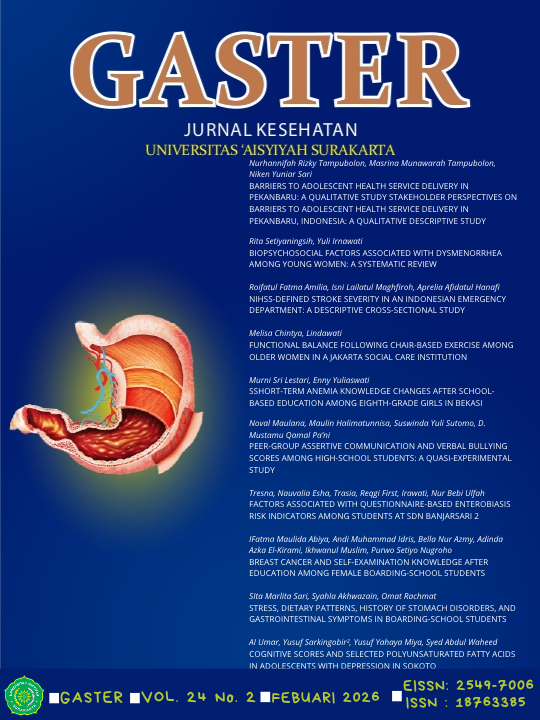
NIHSS-Defined Stroke Severity in an Indonesian Emergency Department: A Descriptive Cross-Sectional Study
DOI:
https://doi.org/10.30787/gaster.v24i2.2592Keywords:
Emergency Department, Stroke Severity, National Institutes of Health Stroke Scale, Stroke, Neurological deficitsAbstract
Introduction: Standardized assessment of neurological deficits is important in acute stroke care, but local distributions of National Institutes of Health Stroke Scale (NIHSS) severity are incompletely reported.
Objective: To describe NIHSS-defined stroke severity and recorded neurological deficit profiles among stroke patients in an emergency department in Bojonegoro, East Java, Indonesia.
Method: This descriptive cross-sectional study enrolled 70 consecutive stroke patients in February–March 2026. Total NIHSS severity categories and individual item distributions were summarized using counts and percentages.
Result: Moderate NIHSS severity (5–15) was recorded in 31 patients (44.3%), severe (16–42) in 29 (41.4%), and mild (1–4) in 10 (14.3%). Ischemic stroke was recorded in 44 (62.9%). Minor facial palsy occurred in 43 (61.4%) and mild-to-moderate sensory loss in 41 (58.6%).
Conclusion: Most patients in this single-department sample were classified as moderate or severe under the study thresholds. Findings describe a local case profile and do not establish stroke prognosis, diagnostic performance, or treatment effectiveness.
References
Azizatunnisa, N., Hartono, A., Suwardi, D. R., Ramadhan, H. N., & Zakaria, E. D. (2024). Effectiveness of emergency room safer transfer of patient (ER-STOP) on patient safety. 32(3). [Lengkapi nama jurnal dan halaman artikel].
Blasini, R., Buchowicz, K. M., Schneider, H., Samans, B., & Sohrabi, K. (2023). Implementation of inclusion and exclusion criteria in clinical studies in OHDSI ATLAS software. Scientific Reports, 13(1), 1-11. https://doi.org/10.1038/s41598-023-49560-w
Chaturvedi, S., Cole, J. W., Kittner, S. J., Cosby-Gaither, C., Doyle, S., Goldstein, L. B., Lennon, O., Levine, D. A., Love, M., Miller, E., Nguyen-Huynh, M., & Rasmussen-Winkler, J. (2024). 2024 guideline for the primary prevention of stroke: A guideline from the American Heart Association/American Stroke Association. https://doi.org/10.1161/STR.0000000000000475
Comer, A. R., Templeton, E., Glidden, M., Bartlett, S., Cruz, L. D., Nemati, D., Zabel, S., & Slaven, J. E. (2023). National Institutes of Health Stroke Scale (NIHSS) scoring inconsistencies between neurologists and emergency room nurses. Frontiers in Neurology, 13, Article 1093392. https://doi.org/10.3389/fneur.2022.1093392
Demarin, A. (2022). Stroke scales as assessment tools in emergency settings. Medicina, 58(11), Article 1541. https://doi.org/10.3390/medicina58111541
Fernandes, M., Westover, M. B., Singhal, A. B., & Zafar, S. F. (2024). Automated extraction of stroke severity from unstructured electronic health records using natural language processing. Journal of the American Heart Association, 13(21), Article e036386. https://doi.org/10.1161/JAHA.124.036386
Firdaus, J., Solikin, & Firdaus, M. W. (2023). The relationship between prehospital delay and severity in stroke patients at Banjarmasin Hospital. Journal of Nursing Invention, 3(2), 108-116. https://doi.org/10.33859/jni.v3i2.274
Fitriana, E. E., & Haryanto, H. (2024). The effectiveness of the National Institutes of Health Stroke Scale (NIHSS) in determining nursing diagnoses in stroke patients: A scoping review. Journal of Nursing Science Update, 12(1), 26-34. https://doi.org/10.21776/ub.jik.2024.012.01.04
Funk, B., Khazai, B., Shim, B., Van Vorst, J., du Preez, L., Anendaga, C. M., & Hollander, M. (2025). Availability and applicability of the National Institute of Health Stroke Scale at time of imaging interpretation for code stroke in the community hospital setting. Journal of the Belgian Society of Radiology, 109(1), Article 22. https://doi.org/10.5334/jbsr.3932
Han, J., Han, C., Park, S., Kim, Y., & Joon, B. (2024). Effect of nurses' detection of neurological deterioration on the prognosis of patients with acute cerebral infarction. Heliyon, 10(12), Article e32175. https://doi.org/10.1016/j.heliyon.2024.e32175
Handayani, I. Y., Isnawati, I. A., & Hamim, H. N. (2023). Factors influencing stroke severity in the Melati Ward of Dr. Haryoto Lumajang Regional Hospital. Mandira Cendikia Health Sciences Journal, 2(10), 543-554. https://journal-mandiracendikia.com/jikmc
Imran, Y., & Zahra, A. A. (2024). The use of NIHSS as an assessment of acute stroke severity. Journal of Society Medicine, 3(2), 31-34. https://doi.org/10.47353/jsocmed.v3i2.128
Maghfirah, C. Z., Ikhsan, M., & Fonna, T. R. (2025). Description of the severity of ischemic stroke based on the National Institute of Health Stroke Scale (NIHSS) score in the neurology inpatient room of Cut Meutia Regional Hospital, North Aceh. Humanity and Health, 8, 483-495. https://jurnal.umpar.ac.id/index.php/makes
Makharia, A., Agarwal, A., Garg, D., Vishnu, V. Y., & Srivastava, M. V. P. (2024). The pitfalls of NIHSS: Time for a new clinical acute stroke severity scoring system in the emergency? Annals of Indian Academy of Neurology, 27(1), 15-18. https://doi.org/10.4103/aian.aian_842_23
Memi, Z., Gurka, E., Ari, M. S., Cetiner, M., Balgetir, F., Eren, F., Eren, A., & Kizilda, N. (2024). Impact of neutrophil-to-lymphocyte ratio on stroke severity and clinical outcome in anterior circulation large vessel occlusion stroke. [Lengkapi nama jurnal, volume, halaman, dan DOI].
Mistry, E. A., Yeatts, S. D., Khatri, P., Mistry, A. M., Detry, M., Viele, K., Harrell, F. E., & Lewis, R. J. (2022). National Institutes of Health Stroke Scale as an outcome in stroke research: Value of ANCOVA over analyzing change from baseline. Stroke, 53(4), e150-e155. https://doi.org/10.1161/STROKEAHA.121.034859
Purnamasari, M., Putri, E., & Rasyid, T. A. (2022). Overview of triage implementation in the emergency room (ER) of Raja Musa Sungai Guntung Regional Hospital, Indragiri Hilir Regency. Hang Tuah Nursing Journal, 2(2), 194-204. https://jom.htp.ac.id/index.php/jkh
Putra, R. D., Murtadho, M. A., Isnaini, M., & Afgani, M. W. (2025). Quantitative research design: Definition and types. Edu Society: Journal of Education, Social Sciences and Community Service, 5(3), 191-199. https://doi.org/10.56832/edu.v5i3.1805
Qureshi, M. M., Strbian, D., Herweh, C., Mohlenbruch, M. A., Raty, S., Olive-Gadea, M., Ribo, M., Psychogios, M., Fischer, U., Nguyen, A., Kuramatsu, J. B., Haupenthal, D., Kohrmann, M., Deuschl, C., Kuhne Escola, J., et al. (2024). Endovascular versus medical therapy in posterior cerebral artery stroke: Role of baseline NIHSS score and occlusion site. Stroke, 55(7), 1787-1797. https://doi.org/10.1161/STROKEAHA.124.047383
Rahman, S., Apriannor, A., & Auliyah, G. R. (2021). Effectiveness of the Siriraj Stroke Score (SSS) and National Institute of Health Stroke Scale (NIHSS) assessment methods in determining actual nursing diagnoses for stroke patients in the emergency room. 12(2), 529-547. https://doi.org/10.33859/dksm.v12i2.741
Roesner, K., Brodowski, H., & Strutz, N. (2025). Measuring severe stroke: A scoping review of RCTs. Frontiers in Neurology, 16, Article 1631275. https://doi.org/10.3389/fneur.2025.1631275
Rout, M., Vaughan, A., Sidorov, E. V., & Sanghera, D. K. (2024). Improving stroke outcome prediction using molecular and machine learning approaches in large vessel occlusion. Journal of Clinical Medicine, 13(19), Article 5917. https://doi.org/10.3390/jcm13195917
Weigel, K., Gaser, C., Brodoehl, S., Wagner, F., Jochmann, E., Gullmar, D., Mayer, T. E., & Klingner, C. M. (2025). Acute stroke severity assessment: The impact of lesion size and functional connectivity. Brain Sciences, 15(7), Article 735. https://doi.org/10.3390/brainsci15070735
World Health Organization. (2022). Global stroke fact sheet 2022. https://www.who.int/news-room/fact-sheets/detail/stroke
Yoon, C. W., & Bushnell, D. (2023). Stroke in women: A review focused on epidemiology, risk factors, and outcomes. Journal of Stroke, 25(1), 2-15. https://doi.org/10.5853/jos.2022.03468
Zhang, L., Ma, J., Wang, M., & Zhang, L. (2024). The association between National Institutes of Health Stroke Scale score and clinical outcome in patients with large core infarctions undergoing endovascular treatment. Neurology and Therapy, 13(3), 563-581. https://doi.org/10.1007/s40120-024-00588-8
Downloads
Published
How to Cite
Issue
Section
License
Copyright (c) 2026 Roifatul Fatma Amallia, Isni Lailatul Maghfiroh, Aprelia Afidatul Hanafi

This work is licensed under a Creative Commons Attribution-ShareAlike 4.0 International License.